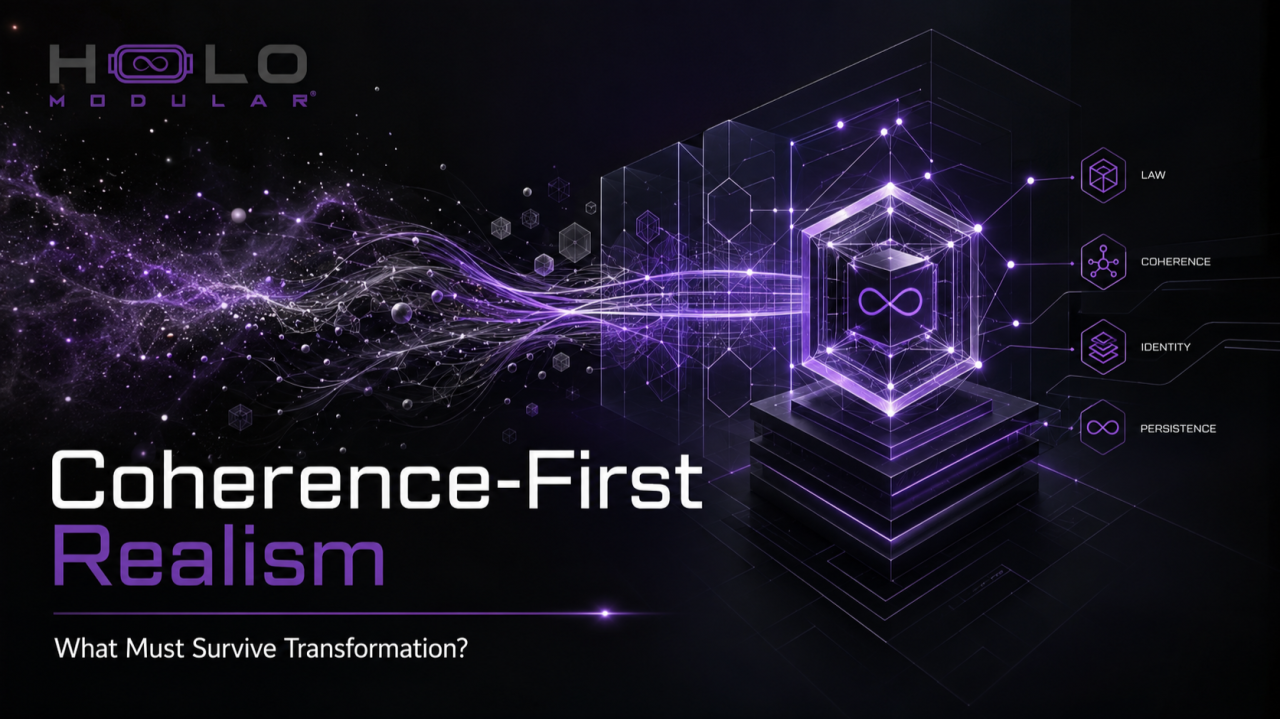
An emerging HoloModular perspective on reality, identity, intelligence, and software systems.
Human intent becomes a model. A model becomes a contract. A contract becomes software. Software becomes storage, behavior, interfaces, and running systems. At every step, the representation changes, yet the transformation succeeds only when something important remains intact.
Meaning must survive.
Coherence-First Realism asks what must remain coherent for something to persist as the same thing through change. It begins with lawful constraints, then considers coherence, stability, boundary, persistence, and thingness.
Coherence is not merely agreement
A false story can be internally coherent. A software model can be elegant and still fail in production. In the stronger sense, coherence is structure that remains mutually compatible while being tested by reality.
A structure becomes more serious when it survives relevant transformations, remains stable under meaningful perturbations, supports reliable counterfactual reasoning, participates in lawful causal interaction, and creates explanatory or predictive loss when removed.
The real is what the world will not let us redescribe away without loss.
Software as a continuity problem
ServiceBricks makes the problem practical. A generated system can compile and still fail to represent the original domain. A database can preserve fields while losing the relationships that made them useful. A migration can move rows successfully while changing authority, behavior, or identity.
This is a developing philosophical framework, not a completed scientific theory. Its purpose is to make the preservation of meaning across transformation visible enough to investigate.